15 December, 2008
Summary
1. The proportion of British born people in work is now the same as in 2001. In effect, the extra 1.34 million jobs created in the past seven years have now virtually all gone to immigrants. A major reason for this is the arrival, since May 2004, of half a million workers from Eastern European members of the EU.
East European Migrant Workers
2. The government relied initially on a Home Office commissioned study which estimated that the net number of migrants from the eight new East European members of the European Union would be between 5,000 and 13,000 a year. Migrationwatch UK described this estimate at the time as "simply not credible".
3. When 170,000 immigrants arrived in the first twelve months, the government claimed that most were here for only a few months. This also proved to be wrong as the number in employment climbed to half a million by the first quarter of 2008. It is now suggested that East Europeans are starting to leave. However, they are also continuing to arrive, although at the lower rate of about 13,000 a month. The Labour Force Survey demonstrates that the number working in the UK has been stable at about 500,000 in the first three quarters of 2008.
Impact on the British born labour force
4. Examination of the Labour Force Survey since 1997 shows a very clear pattern displayed in the graph below (which is based on the Tables in Annex A):
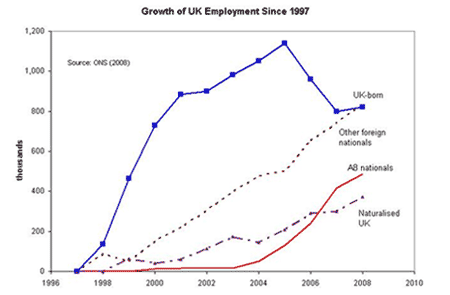
5. Employment of British born workers and of migrant workers both increased as the economy grew between 1997 and 2004. However, the arrival of East European migrants after 2004 coincided with a sharp fall in the employment of British born workers. The British born working age population also fell during this period, so the proportion in work remained unchanged at 75.4%. Despite the considerable growth of total employment, there has been no progress at all in getting British born unemployed workers back to work after 2004. Most of the jobs created since 2004 have gone to East Europeans, and all of the rest have gone to other migrants. (It is important to be clear that "British Born" includes all those born in Britain, whatever the origin of their parents; it does not include migrants who have since become British citizens they are shown as "Naturalised UK")
6. These employment statistics are not, in themselves, absolute proof that the employment of British born workers has declined as the result of East European immigration but it is hard to find another explanation. The government have claimed that there has been "no significant impact" on British employment. This is misleading. What they are referring to is the Gilpin study for the Department of Work and Pensions.
[1] This looked at various regions and found
large "long-run" effects of A8 immigration, but the estimates were "statistically
insignificant". This means that they are not statistically reliable. It does not necessarily mean that they are small which is how the general public would interpret the expression. What it does mean is that there is no firm evidence about the size of the effect and that the statistics are not clear enough to prove the point either way. The reason for this is that, with a UK workforce of 29 million, an extra half a million is a relatively small amount - especially when scattered across the country. Any effect they may have is further complicated by internal migration and by other changes in a flexible economy. However, it is now possible to take the workforce as a whole over a period of years and to see that there has been a clear impact on British employment. This corresponds with widespread anecdotal evidence.
7. The impact of East European workers has not been entirely negative. They have acquired a well justified reputation for hard work. They have also been a boon to employers by providing a very capable work force at close to the minimum wage. (80% of East Europeans earn less than £6 an hour).
8. It is also important to note that there is not a fixed number of jobs in the economy. The labour force is one variable among many. To the extent that East Europeans undertake work that British workers would not have done, they have added to the number of jobs. They also add to demand and therefore add indirectly to the labour force requirement. That said, it seems an inescapable conclusion that the sudden arrival of a very large number of very capable workers willing to work for low pay has had a negative impact on the employment of British born workers at the bottom of the pay scale. If any further argument was needed against lifting the restrictions on access to Britain for Romanian and Bulgarian workers, this is it.
Annex A - View Larger Image Click here

Footnotes
- Gilpin, N., M. Henty, S. Lemos, J. Portes and C. Bullen (2006),"The impact of free movement of workers from Central and Eastern Europe on the UK labour market", DWP Working Paper No 29.
- Gilpin, N., M. Henty, S. Lemos, J. Portes and C. Bullen (2006),"The impact of free movement of workers from Central and Eastern Europe on the UK labour market", DWP Working Paper No 29.